Justice For All's Burma Task Force is heartened by the International Criminal Court (ICC) Prosecutor…
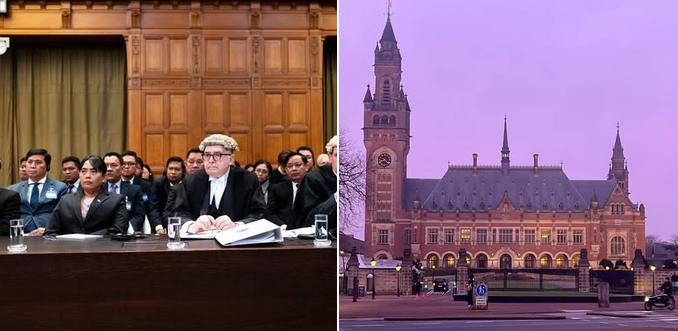
Summary Report by Hena Zuberi: A trip to The Hague for the Genocide case against Myanmar
Justice For All at the International Court of Justice
Background:
WATCH: What is the International Court of Justice.. What can it do, and what can it not do?
The ICJ held final public hearings on the Genocide case brought by the Gambia against Myanmar. As our Burma Task Force has been exemplifying for the last 15 years, what happened to the Rohingya is Genocide. Alhamdulillah, this was accepted by the United States and other countries.
Our field-office at the camps documented many stories of victims. That body of data, along with strategic access to country representatives, finally had The Gambia file a case against Myanmar in 2019. Six years later that filing came to a zenith in its progress. We are now awaiting the ruling from the ICJ.
This judgment will have ramifications beyond Myanmar. There are cases by South Africa against Israel, and the world will watch as one judgment may have profound effects on the other. Why this is important is that this is the first time that a third party (The Gambia) has taken the perpetrator (Myanmar) to court for the genocide of people that are indigenous to its (Myanmar’s) own territorial extent.
What’s at stake is not just a ruling, but the moral authority of international justice. Genocide against one, in this case the Rohingya, is a crime against humanity.
- 350+ villages destroyed
- 6,000+ killed in weeks
- 750,000+ forced into Cox’s Bazar
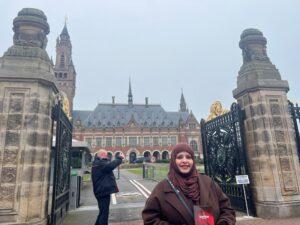
Hena Zuberi, Justice For All’s Burma Task Force interim lead was at the Hague as an observer. Her reports are below.
DAY 3: On the conclusion of the hearings:
As the International Court of Justice hearings in the genocide case brought by The Gambia concluded Myanmar, also known as Burma, finished their closing presentation in the merits phase of the case.
This second round of oral arguments focused on Burma’s response to the evidence presented against it. Inside the courtroom, Burma’s legal team sought to undermine the credibility of the U.N. Independent International Fact-Finding Mission on Myanmar, questioning the qualifications and impartiality of its staff and arguing that its findings should not be relied upon by the Court.
It is worth recalling that in March 2017, the U.N. Human Rights Council established the Independent International Fact-Finding Mission on Myanmar to investigate alleged violations by military and security forces. The mission’s mandate concluded in September 2019, but its findings continue to underpin international accountability efforts.
Burma’s lawyers also repeated a long-standing position: denying the Rohingya identity altogether. Throughout today’s presentation, they referred to the Rohingya as “Bengalis,” insisting they are Bangladeshi nationals rather than a protected ethnic group in Burma. That framing is central to Burma’s defense, because it attempts to strip the Rohingya of protection under the Genocide Convention. Rohingya diaspora leaders reacted strongly to this erasure.
That language also prompted a response from Bangladesh, which hosts nearly one million Rohingya refugees. In a statement issued from Dhaka, Bangladesh condemned Burma’s use of the term “Bengalis” during the ICJ proceedings, characterizing it as an attempt to portray the Rohingya as illegal immigrants and security threats rather than victims of mass atrocities.
Burma’s legal team also argued that because hundreds of thousands of Rohingya are still alive, genocide could not have occurred; a claim that legal experts say misunderstands international law, which does not require the total destruction of a group to be considered as a genocide.
READ: The Genocide Convention
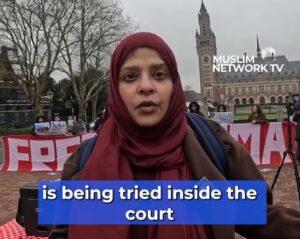
DAY 2: From inside the ICJ:
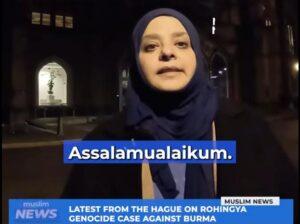
I wanted to share a brief update from the International Court of Justice in The Hague where testimony we gathered 9 years ago is being used.
I just witnessed the conclusion of The Gambia’s presentation in its genocide case against Burma (Myanmar), and I want to say clearly: the Gambian legal team did an outstanding job. Their presentation yesterday was rigorous, precise, and deeply grounded in both law and evidence.
One moment that stood out to me was when judges asked how many Rohingya actually lived in northern Rakhine State, given that Myanmar has long refused to officially register the Rohingya and claims there are no reliable population figures. In response, the Gambian team skillfully used Myanmar’s own report to answer the Court, adding the various figures.
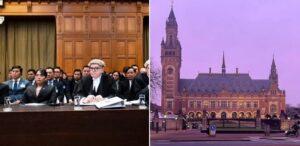
Those documents showed that nearly two-thirds of the Rohingya population lived in just three townships, the very townships that were most heavily targeted during the 2016 and 2017 military operations. This was powerful, because it demonstrated not just scale, but deliberate and strategic targeting.
Another critical point the Gambian team emphasized, and one I think is important for all of us to understand, is the difference between motive and intent. Under international law, motive doesn’t matter. What matters is intent: intent to destroy a protected group, in whole or in part. And that intent can be inferred from patterns of conduct, mass killings, sexual violence, village burnings, forced displacement, and the deliberate creation of conditions that make life impossible for a people to survive.
Earlier this week, the Court also heard rare closed testimony from Rohingya victims, including deeply painful accounts that underscored why privacy and protection were necessary.
Being there in person, it was clear that this case matters far beyond Myanmar. What the Court decides here will shape how genocidal intent is understood and proven in international law, especially when states try to hide behind “security” narratives.
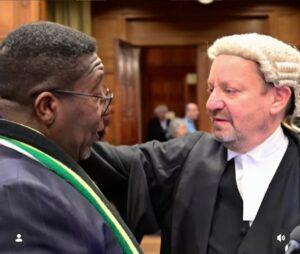
DAY 1: On getting to The Hague, Netherlands:
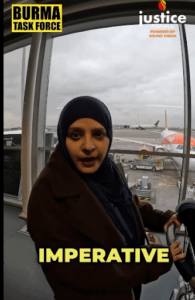
WATCH: “What is at stake, is the moral imperative of the International Courts.”

Related Posts