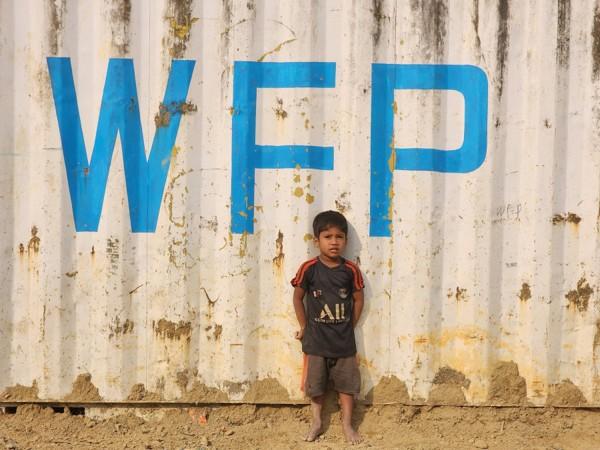
WFP Injustice to Vulnerable Rohingya Refugees A photo essay on the Targeting and Prioritization…
A Ration Card, but No Roof
A Ration Card, But No Roof
How newly arrived Rohingya survive in Cox’s Bazar: fed by WFP, but left to find their own shelter
Words and photographs by Abdullah Bawshore · November 2026
I was born into this story. Every Rohingya of my generation was. We have learned the shape of leaving: the night walk, the river, the border, the camp. And still, every new family that crosses from Arakan teaches me that there is one more step of loss I had not counted.
Since 2024, war between the Myanmar military and the Arakan Army has pushed a new wave of our people across the Naf River. The World Food Programme counts more than 150,000 new arrivals in Bangladesh since then. They come into camps that already hold more than a million Rohingya, crowded into 33 camps in Cox’s Bazar.
The new arrivals have been registered and they collect WFP rations. But food is only half of survival. What they have not been given, by the government or by the international organisations, is a shelter of their own. So they live wherever someone will make room: on the floor of a relative’s shelter, in a rented corner they pay for out of nothing, under a tarpaulin stretched over burned ground.
These photographs are of my people, in that in-between place. They are fed, but they are not housed.
The road that never empties
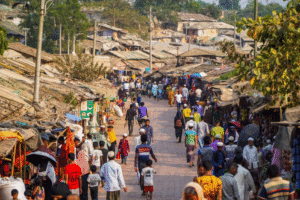
PHOTO: ABDULLAH BAWSHORE
The main bazaar road of the camp is full from morning to night. Shopkeepers sell clothes, vegetables, footballs and plastic slippers from bamboo stalls. Men in white caps, women in burqas, children running between them. For people who arrived years ago, this road is a kind of life. For the new arrivals, it is a place to look for anything: a day’s labour, a cheap room, a cousin who might have space.
Carrying everything uphill
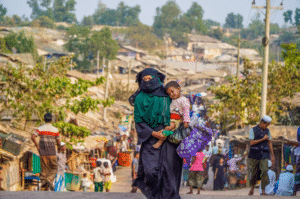
PHOTO: ABDULLAH BAWSHORE
A mother climbs the brick road with her son on her hip. In one hand a soft drink bottle, in the other a plastic bag of vegetables and a folded umbrella. This is the daily journey: from the distribution point or the bazaar back to a shelter that is not hers.
The ration is real, and it keeps families alive. But it was never meant to carry everything. In April 2026 WFP moved to targeted assistance, and the monthly ration of $12 per person was cut to $10 or $7 for households judged to be at lower risk. A family that also has to pay rent, or contribute to the household that hosts them, feels every dollar of that cut.
Living in someone else’s home
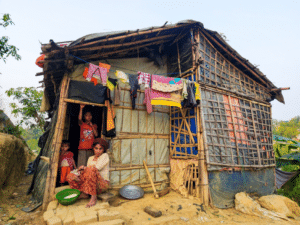
PHOTO: ABDULLAH BAWSHORE
This shelter belongs to a host family. Bamboo frames, tarpaulin walls patched with whatever plastic could be found, a line of children’s clothes drying across the front. Inside, two households share the space meant for one.
The Rohingya way is to open the door. No family will turn away a relative who has crossed the border with nothing. But generosity has a limit when the walls are bamboo and the ration was already small. The host family’s rice now feeds more mouths. The children sleep closer together. Nobody complains out loud, but everyone counts.
A corner and a crutch
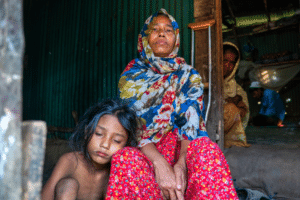
PHOTO: ABDULLAH BAWSHORE
In a dark room of corrugated tin, a mother sits with her daughter asleep against her knee. A crutch leans on the wooden post behind them. An older woman watches from the shadows inside.
For families like this, a rented room is not a choice; it is the only option left. Rent must be found somewhere: from the ration, from borrowing, from a son who finds a day’s work. When the money runs out, they move again, to another relative, to another corner.
Waiting on burned ground
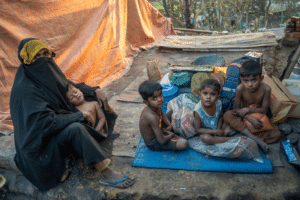
PHOTO: ABDULLAH BAWSHORE
This family sits on ground blackened by fire. Their life is packed into sacks, a school backpack, a blue water drum and a carton of WFP fortified biscuits. An orange tarpaulin is the only wall. The mother holds her youngest, asleep in her lap; the three boys look straight into the camera.
They are not travelling. They are waiting: for a space, for permission, for anyone to tell them where they may stay. Without an allocated shelter, a family is always one argument, one fire, or one unpaid rent away from the open ground.
Night in a plastic house
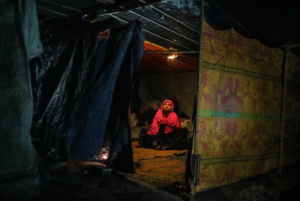
PHOTO: ABDULLAH BAWSHORE
After dark, a single small bulb lights a shelter made of tarpaulin and cloth sheets tied to poles. A girl in a pink scarf sits on a mat and looks up at the roof.
These walls do not stop the wind. In monsoon season, they do not stop the rain. In the cold months, they hold no heat. This is what “shelter” means for many new arrivals: not a house, but something tied together with rope, waiting for a proper place that has not come.
Looking toward home
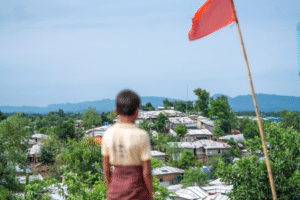
PHOTO: ABDULLAH BAWSHORE
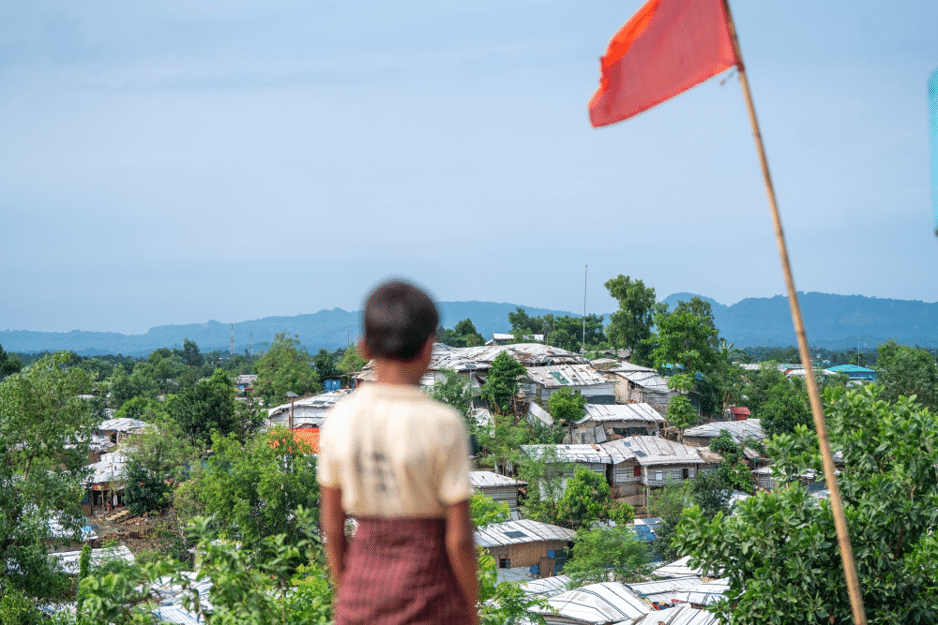
From the top of a hill, a boy looks over the rooftops toward the mountains on the horizon. Beyond them is Arakan, the land his family ran from. A small red flag flies on a bamboo pole beside him.
I do not know what he is thinking. I know what I thought at his age, standing on the same kind of hill. I wanted to go home. I wanted to go home safely, with my rights, my land and my name. That is still what every Rohingya wants.
What these families need
Rice keeps a family alive for a day. A roof lets them begin to live. The new arrivals I photograph are not asking for much: a registered shelter, a place on the shelter list, a few square metres where no one can ask them to leave.
Until the Government of Bangladesh and the humanitarian agencies give newly arrived Rohingya a shelter of their own, they will keep living on the goodwill of relatives and the mercy of landlords, while the ration that feeds them grows smaller.
We have been refugees for a long time. We know how to wait. But waiting without a roof is a different kind of waiting.
— Abdullah Bawshore, Rohingya storyteller and documentary photographer, Cox’s Bazar
Photo credits
All photographs © Abdullah Bawshore. All rights reserved. Not to be reproduced without permission.
Sources: WFP figures on new arrivals and the April 2026 ration change as reported by Arab News and UNB; camp population from Arab News.

Related Posts