
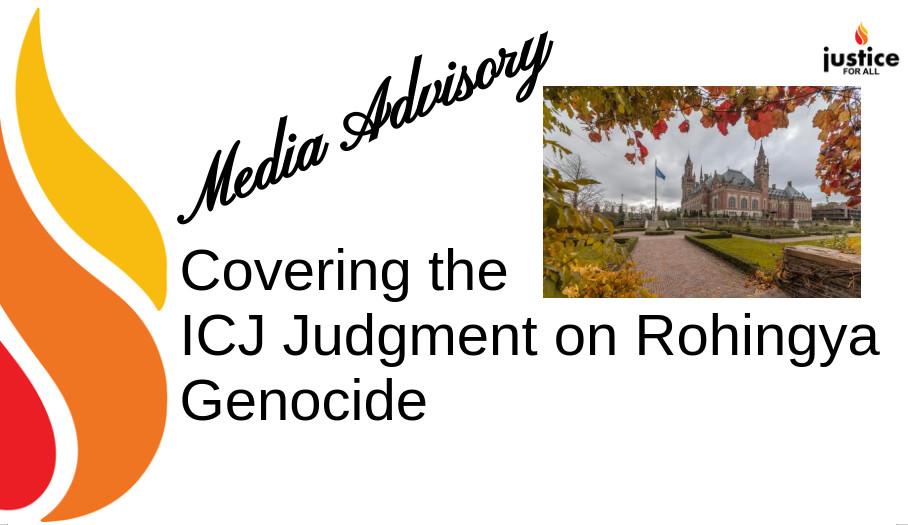
Covering the ICJ Judgment on the Rohingya Genocide
Justice For All media guide
Nov. 18, 2026
The International Court of Justice is scheduled to issue its judgment tomorrow, Nov. 19, in The Gambia v. Myanmar. The Court’s hearing is scheduled for 10 a.m. in The Hague.
Justice For All’s Burma Task Force urges newsrooms to place the judgment in the context of the Rohingya’s history, identity and continuing persecution. The decision is a major legal development, but it is not the end of the story.
Core guidance for coverage
Explain what the Court is deciding. The ICJ case concerns Burma’s (Myanmar’s) state responsibility under the Genocide Convention. It is not a criminal trial of individual military or government officials. Keep the ICJ distinct from the International Criminal Court, which can prosecute individuals.
Do not present the genocide as a sudden crisis that began in 2017. The mass atrocities and forced displacement of 2016 and 2017 were a devastating escalation in decades of persecution, discrimination and repeated displacement. Burma Task Force has documented successive waves of genocidal violence; UN and historical accounts also describe major waves of flight in 1978, 1991-92, 2012, 2016 and 2017. Burma Task Force
Report that the genocide continues, and attribute that position accurately. Justice For All’s position is that the genocide is ongoing. Recent U.N. reporting documents widespread and systematic abuses against Rohingya by both the Burmese military and the Arakan Army, including forced displacement, sexual violence, forced labor, land confiscation and destruction of villages and religious and cultural sites. Do not imply these findings mean the two actors have identical roles or histories.
Do not erase the religious dimension. The Rohingya are a predominantly Muslim people. Anti-Muslim rhetoric and Buddhist nationalist campaigns helped portray them as a threat to Buddhism and Myanmar, while authorities restricted Muslim religious practice. Report the role of those movements and policies without blaming Buddhists as a whole or reducing the violence to an ancient “Buddhist-Muslim conflict.”
Recognize Rohingya identity and homeland. Justice For All recognizes the Rohingya as an Indigenous people of Arakan, their ancestral homeland in what is now Rakhine State. The Myanmar state’s denial of the Rohingya name and identity should not be presented as proof that the community does not exist. When discussing historical scholarship, distinguish debate over particular historical accounts from the documented use of identity denial to marginalize Rohingya.
Avoid repeating misinformation
The U.N. Independent Investigative Mechanism for Myanmar has documented official and other public narratives that deny Rohingya identity and portray the community as foreign, illegal or a terrorist threat. Newsrooms should not repeat those claims as neutral facts.
| Avoid this framing | Use this context |
| “Bengali” as a substitute for Rohingya | Use Rohingya, the community’s name. If an official uses “Bengali,” make clear that it is a contested label used to cast Rohingya as foreign migrants. |
| “There is no Rohingya ethnic group” | Burma’s refusal to recognize an identity does not make that identity nonexistent. |
| “Illegal immigrants” or “foreigners” | Do not repeat these descriptions as fact. Burmese authorities have used them to deny Rohingya belonging and rights. |
| “The military responded to terrorism” as a complete explanation | ARSA attacks on security posts occurred. They do not justify collective punishment or atrocities against Rohingya civilians. Do not conflate Rohingya civilians with armed groups. |
| “An ancient communal conflict” or “violence between two sides” | Explain the state policies, military operations, nationalist incitement and power imbalance involved. Also report abuses by the Arakan Army without flattening distinct actors and events into a false equivalence. |
| “The stateless Rohingya” as an identity label | Do not imply that Rohingya lack a homeland or identity. Describe Burma’s denial of citizenship and explain the resulting legal status only when it is relevant. |
| “The verdict ends the genocide” | Explain that implementation, protection, accountability and the restoration of Rohingya rights remain unresolved. |
Background: territory and regional interests
Northern Rakhine, especially Maungdaw and Buthidaung, is a historic Rohingya homeland and included Rohingya-majority areas. Rakhine State also occupies a strategic position on the Bay of Bengal. The region includes offshore gas and energy infrastructure, China-Myanmar oil and gas pipelines, the planned Kyaukphyu deep-sea port and economic zone, and India’s Kaladan transport corridor.
These projects shape regional interests and strategic relationships involving Burma, China, India and Bangladesh. Recent analysis describes how shifts in control of territory and infrastructure have increased the Arakan Army’s leverage with regional actors. We urge reporters to cover that context, while separating documented facts from interpretation: the projects’ strategic importance does not, by itself, establish that competition over resources caused the genocide.
Suggested language
- “Rohingya people from their ancestral homeland in northern Rakhine State”
- “Myanmar’s military, known as the Tatmadaw”
- “The Arakan Army, an armed group that has also been accused of serious abuses against Rohingya”
- “Justice For All says the genocide is ongoing; recent U.N. reporting documents widespread and systematic abuses by the Myanmar military and Arakan Army.”
For interviews or additional information: Hena Zuberi, Justice For All | hena@justiceforall.org
Editorial precision before publication: Many Rohingya are legally stateless because Myanmar denied them citizenship. I recommend telling outlets not to use “stateless” as a shorthand for Rohingya identity or as a suggestion that they have no homeland. Saying that Myanmar denied citizenship to many Rohingya preserves the distinction between their homeland and the state-imposed legal status. Also, because “Indigenous” is contested in some historical scholarship, this guide presents indigeneity explicitly as Justice For All’s position.
Additional Resources:
